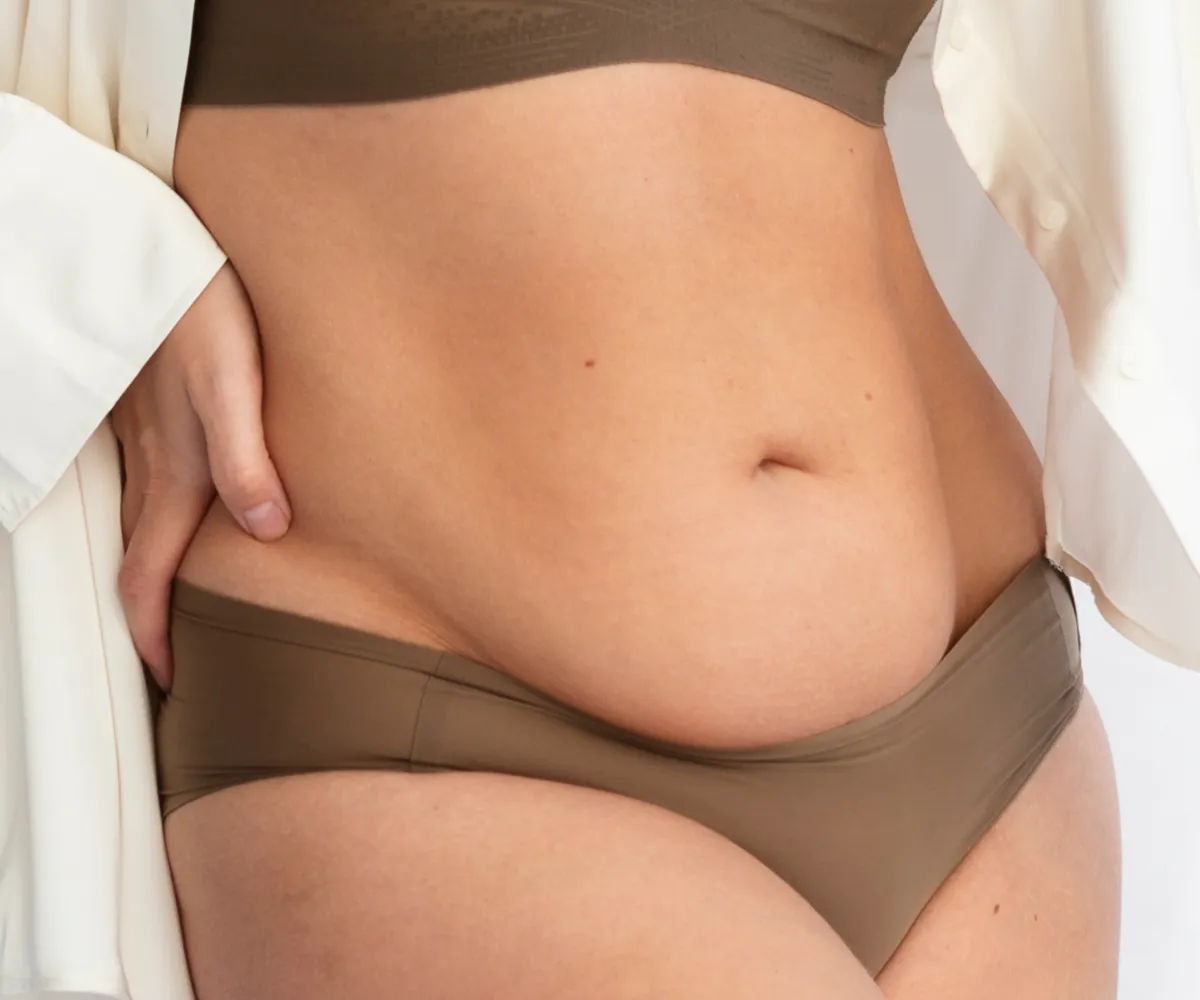
Stubborn tummy changes after pregnancy or weight loss?
Loose skin, stretched abdominal muscles, and stubborn fat may not fully respond to exercise. A tummy tuck can address selected concerns.
There is a limit to what diet and exercise can do for the abdomen. The separation of the rectus abdominis muscles — diastasis — doesn't close with crunches. Skin that has lost its elasticity does not recover with creams. Stubborn fat on the flanks and upper abdomen doesn't respond to exercise. These are anatomical issues, and an HD tummy tuck combined with liposuction treats all of them at once, with a level of precision and safety that a conventional tummy tuck alone can't match.
With more than 200 real patient reviews on Google and surgeries performed at Hospital Glória D'Or (Glória, South Zone of Rio), Dr. Alexandre Charão — a plastic surgeon recognized by SBCP, AMB and CFM, and a member of BAPS, with a clinic in Botafogo — uses a four-part approach grounded in leading Brazilian and international research.
What Can an HD Tummy Tuck Address?
A personalized plan can address loose skin, abdominal muscle separation, and areas of stubborn fat.
Diastasis repair (muscle tightening)
Plication of the rectus abdominis fascia restores the abdominal wall, can help improve a protruding abdominal contour when muscle separation is a contributing factor and restores the silhouette — the component that no liposuction alone can treat. Dr. Charão's approach follows internationally recognized systems for classifying and treating the abdomen.
360° VASER liposuction
Lipoabdominoplasty with selective undermining — validated in a series of 445 patients1 — preserves the perforating vessels of the abdominal flap and allows safe liposuction of areas previously considered high-risk. VASER selectively emulsifies fat2 before suction, reducing vascular trauma. Combining VASER with a tummy tuck, as described in the high-definition body contouring literature, produces better skin tightening and a more refined aesthetic result than either technique alone.
Muscle definition with HD etching and intramuscular fat transfer
After liposuction, HD sculpting of the abdominal anatomical lines — linea alba, semilunar lines and tendinous intersections — creates three-dimensional definition that conventional abdominoplasty does not offer. In selected cases, intramuscular fat transfer with processed fat (UGRAFT) enhances the projection of the rectus abdominis muscles, producing an athletic look even at rest.
Skin removal with Baroudi stitches and a discreet scar
Baroudi stitches, named after Brazilian plastic surgeon Dr. Ramil Baroudi, help prevent seroma (fluid buildup) and, in most cases, eliminate the need for drains. They are applied across the entire treated area. The scar is individually designed to stay hidden under your underwear or bikini line.
What's recovery like, and when can you get back to your routine?
With Fast Track Recovery, an HD tummy tuck is far less disruptive than most people expect.
The Pre-Surgery Metabolic Program starts as soon as the surgery is scheduled — essential in this procedure, where nutritional and metabolic status directly determines scar quality and how long the result lasts. Fast Track Recovery begins in the operating room, with an advanced pain-management approach designed to keep you comfortable. Each patient gets a private WhatsApp group with direct access to Dr. Charão throughout your recovery.
O Globo's "Faz a Diferença" (Makes a Difference) Award (2006) and the feature in The Washington Post — whose journalists came to Rio specifically to follow Dr. Charão's surgeries — reflect results achieved since 2004 that transform not only bodies, but life stories. Full career in Dr. Alexandre Charão's background. All surgeries are performed at Hospital Glória D'Or, in the Glória neighborhood, South Zone, part of Rede D'Or, the largest hospital network in Brazil, with annual JCI accreditation.
Conventional vs. HD Tummy Tuck
See how Dr. Alexandre Charão's high-definition technique compares to a conventional tummy tuck:
| Criteria | Conventional tummy tuck | HD Tummy Tuck — Dr. Alexandre Charão |
|---|---|---|
|
Diastasis correction
|
• Performed in both | ✓ Plication + VASER high-definition contouring |
|
Liposuction of the flap
|
✕ Limited or none | ✓ Selective lipoabdominoplasty — validated in 445 patients |
|
Liposuction technology
|
• Conventional mechanical | ✓ VASER ultrasound — selective emulsification and skin tightening for HD contouring |
|
Muscle definition
|
✕ Not performed | ✓ Three-dimensional HD etching + UGRAFT when indicated |
|
Seroma prevention
|
✕ Conventional drains | ✓ Baroudi stitches — usually no drains |
|
Preoperative preparation
|
• Fasting and basic lab tests | ✓ Pre-Surgery Metabolic Program |
|
Recovery
|
✕ 8 to 12 weeks of restrictions | ✓ Fast Track Recovery: faster, more comfortable recovery |
|
Hospital
|
• Varies | ✓ Hospital Glória D'Or (Rede D'Or) — JCI-accredited |
HD Tummy Tuck FAQ
What is abdominal diastasis and how does surgery fix it?
Diastasis is the separation of the rectus abdominis muscles that does not respond to exercise. Abdominoplasty corrects it definitively through fascial plication — bringing the muscles back together and permanently restoring the function and appearance of the abdominal wall.
Why use VASER in abdominoplasty if skin is already being removed?
VASER allows safe liposuction of areas such as the upper abdomen and flanks that would be high-risk with the conventional technique, thanks to selective emulsification with less vascular trauma and selective undermining that preserves the perforating vessels — a result documented in a series of 445 patients.
What are Baroudi stitches and why are they important?
They are adhesion stitches between the skin flap and the abdominal fascia, developed by Brazilian plastic surgeon Dr. Ramil Baroudi. They close the dead space left after undermining, preventing seroma — the most common complication of abdominoplasty. In most cases, they eliminate the need for drains, reducing discomfort and recovery time.
What is abdominal etching and who can have it?
It is the sculpting of the abdominal anatomical lines with VASER to create three-dimensional definition. It suits patients with good underlying muscle tone, skin with adequate elasticity and a body fat percentage within the selection criteria. The result is an athletic-looking abdomen even at rest.
What is intramuscular fat transfer (UGRAFT) and when is it indicated?
The fat removed during liposuction is reinjected under ultrasound guidance into the rectus abdominis muscles, enhancing the definition achieved with etching and creating real muscle volume. It is indicated for patients who want a more athletic result and have enough fat available.
How long does recovery take with Fast Track Recovery?
Most patients return to light activities within 10 to 14 days, start walking in the first week and resume moderate exercise after 6 weeks. The private WhatsApp group ensures direct follow-up with Dr. Charão throughout recovery.
Does the Pre-Surgery Metabolic Program affect my tummy tuck results?
Yes — especially scar quality and how long the result lasts. Nutritional and metabolic status at the time of surgery determines collagen production and the healing response. The Pre-Surgery Metabolic Program optimizes these factors before surgery.
Where does Dr. Charão perform HD tummy tucks?
At Hospital Glória D'Or, in the Glória neighborhood, South Zone of Rio de Janeiro — part of Rede D'Or, with annual JCI accreditation. The consultation clinic is in Botafogo, also in the South Zone. Care is available in Portuguese, English and French. See also Dr. Alexandre Charão's background.
Ready to start your HD tummy tuck journey?
Schedule an in-person consultation in Botafogo or a private virtual consultation directly with Dr. Alexandre Charão's team.
📅 Schedule your consultation on WhatsApp📚 Scientific Bibliography
- Saldanha OR, et al. Lipoabdominoplasty. Plast Reconstr Surg. 2009;124(3):934-942. doi:10.1097/PRS.0b013e3181b037e3
- Hoyos AE, Millard JA. VASER-assisted high-definition liposculpture. Aesthet Surg J. 2007;27(6):594-604. doi:10.1016/j.asj.2007.08.007